| Nikita Khrushchev | |
| |
| Historical Figure | |
| Nationality: | Russian citizen of the Soviet Union (born in the Russian Empire) |
| Year of Birth: | 1894 |
| Year of Death: | 1971 |
| Cause of Death: | Heart attack |
| Religion: | Atheist |
| Occupation: | Soldier, Politician, Author of Non-Fiction |
| Spouse: | Yefrosinia; Marusia (separated); Nina |
| Children: | Five |
| Military Branch: | Red Army (World War II) |
| Political Party: | Communist Party of the Soviet Union |
| Political Office(s): | First Secretary of the Communist Party of the Soviet Union (1953-1964) |
| Fictional Appearances: | |
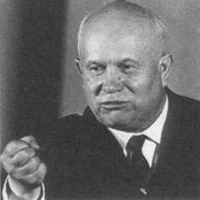
Nikita Sergeyevich Khrushchev (Никита Сергеевич Хрущёв) (15 April 1894 - 11 September 1971) was a Soviet politician who served as leader from 1953 to 1964. His reign coincided with a crucial phase of the Cold War. While he instituted a number of reforms and backed the Soviet space program, certain foreign policy missteps prompted his colleagues to remove him from power.
A veteran of World War II, he served as First Secretary of the Communist Party of the Soviet Union from 1953 to 1964, following the death of Joseph Stalin, and Chairman of the Council of Ministers from 1958 to 1964. After briefly sharing power with Georgy Malenkov from 1953 to 1955, Khrushchev was able to outmaneuver and out Malenkov. During his rule, Khrushchev was responsible for the partial de-Stalinization of the Soviet Union, which he began on 25 February 1956, when he delivered the "Secret Speech", vilifying Stalin and ushering in a less repressive era in USSR. However, Khrushchev omitted mention of his own complicity in Stalin's brutality, and his own efforts at reform were not terribly effective. He survived a coup within the Party, when several hardline Stalinists attempted to oust him in 1957, but he became increasingly autocratic in his reign.
Khrushchev backed the progress of the world's early space program. It was during his reign that the USSR launched Sputnik. He was initially a relatively popular figure in the US, and a 1959 state visit helped to thaw relations between the Cold War antagonists. In 1960, however, he angered the West with an extreme outburst during a speech by the head of the Filipino delegation to the UN calling for an end to imperialism by the USSR as well as by Western countries.
His dubious efforts at domestic reform plus several crises between his country and the United States (including the Cuban Missile Crisis) helped to erode his colleagues' confidence in him. Khrushchev was removed from power in 1964 (the only Soviet leader to experience this), and replaced with Leonid Brezhnev. Khrushchev was allowed to live the remainder of his life in relative peace. He died in 1971.
Nikita Khrushchev in The Hot War[]
| The Hot War POD: November, 1950 | |
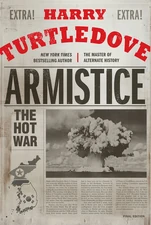
| Appearance(s): | Armistice |
| Type of Appearance: | Contemporary reference |
Nikita Khrushchev was one of several Soviet politicians who survived World War III and the death of Joseph Stalin in June 1952. During a conversation with President Harry Truman, George Kennan suggested that Khrushchev might be in the running to take power from Stalin's immediate successor, Lavrenty Beria. Kennan described Khrushchev as being an up-and-comer, and that he was nye kutlyurny, uncultured, a trait he played to keep himself alive during Stalin's reign. Truman had never heard of Khrushchev, but made sure to remember him from then on.[1]
Nikita Khrushchev in Worldwar[]
| Worldwar POD: May 30, 1942 | |
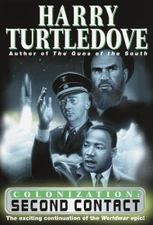
| Appearance(s): | Second Contact |
| Type of Appearance: | Direct |
| Date of Death: | Unknown |
| Military Branch: | Red Army (WWII, Race Invasion of Tosev 3) |
Nikita Sergeyevich Khrushchev was General Secretary of the Communist Party of the Ukrainian Soviet Socialist Republic, which equated to being more or less governor of that province.[2]
Khruschev resisted separatist guerrilla bands supported both by Germany and the Race. Germany supported these through its ally Romania, which allowed the Germans to disavow any involvement in the gun-running when the Soviet Union protested to them and the Romanians to claim they were at the mercy of their German ally when the Soviets protested to them.[3]
In 1963, Khrushchev was able to present his superior (and sometime political rival), General Secretary Vyacheslav Molotov of the Communist Party, with evidence that the Race was supporting the rebels. Molotov was hopeful that the Race, unlike Germany, would discontinue its support for the rebels on being confronted with this evidence.[4]
In 2031, members of the Race on Home recalled Khrushchev had once threatened that "we will bury you". In light of the development of Tosevite starships, the Race considered his threat very possible, generations after he made it.[5]
Nikita Khrushchev in The War That Came Early[]
| The War That Came Early POD: July 20, 1936; Relevant POD: September 29, 1938 | |
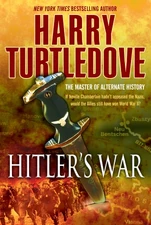
| Appearance(s): | Hitler's War |
| Type of Appearance: | Contemporary reference |
Nikita Khrushchev was the head of the Communist Party of the Ukraine at the outbreak of the Second World War. He'd survived Joseph Stalin's purges.
Ivan Kuchkov reminded Sergei Yaroslavsky of Khrushchev. Both seemed to be bullheaded and dim, and yet, if Khrushchev survived the purges, he had to have been quite clever beneath his exterior. Yaroslavsky suspected Kurchov capable of similar depths.[6]
Nikita Khrushchev in "The Phantom Tolbukhin"[]
| "The Phantom Tolbukhin" POD: c. 1937 | |
| Type of Appearance: | Direct |
| Occupation: | Partisan |
| Affiliations: | Fourth Ukrainian Front |

Nikita Khrushchev was the political officer in Fedor Tolbukhin's "Fourth Ukrainian Front", a rag-tag guerrilla band of Soviet soldiers fighting a desperate guerrilla war against German occupation in 1947. Unlike most political officers, Khrushchev was quite willing to take up arms and go into battle, a trait Tolbukhin appreciated. With the Soviet government in disarray and Moscow occupied, Khrushchev's power as a political officer was less than he cared to admit.
Khrushchev accompanied Tolbukhin on a daring raid on the Ukrainian city of Zaporozhye, killing several German soldiers and destroying a munitions factory.[7]
See Also[]
- Georgy Malenkov, who succeeded Chairman of the Council of Ministers of the Soviet Union in OTL. He briefly shared power with Khrushchev until Khrushchev was able to arrange his ouster, becoming the sole leader of the country.
- Vyacheslav Molotov, longtime foreign minister of the Soviet Union and close adviser of Joseph Stalin in OTL. In Worldwar, Molotov succeeds Stalin as leader of the USSR, not Khrushchev.
- Lavrenty Beria, head of the MGB at Stalin's death in OTL, he seemed poised to take sole power before he was arrested and executed for crimes against the state. In The Hot War, Beria briefly succeeds Stalin in 1952 before Molotov helps oust him. In Worldwar, Beria attempts to oust Molotov in 1963, and fails.
References[]
- ↑ Armistice, p. 105, HC; loc. 1793-1805, ebook.
- ↑ Second Contact, pg. 522.
- ↑ Ibid.
- ↑ Ibid., pg. 523.
- ↑ Homeward Bound, pg. 532, pb.
- ↑ Hitler's War, pg. 410.
- ↑ See, e.g., Counting Up, Counting Down, pgs. 105-118.
| Political offices (OTL) | ||
|---|---|---|
| Preceded by Nikolai Bulganin |
Chairman of the Council of Ministers (de facto head of government) of the Soviet Union Council of People's Commissars until 1946 1958–1964 |
Succeeded by Alexei Kosygin |
| Party political offices (OTL) | ||
| Preceded by Georgy Malenkov as de facto party leader without formal title |
First Secretary of the Communist Party of the Soviet Union (de facto leader of the Soviet Union) 1953-1964 |
Succeeded by Leonid Brezhnev as First Secretary |
| ||||||||||||||||||||||
| |||||||||||||||||||||
| |||||||||||
| ||||||||||||||||||||||
| |||||||||||||||||||||||||